1. Brakes: Tell me how you’d check that the brakes are working before starting a journey.
Brakes should not feel spongy or slack. Test them as you set off, and check that the vehicle does not pull to one side.
Practise the vehicle safety questions you may be asked on your practical driving test. This guide uses photographs from Joe’s teaching car to help you recognise the controls and engine components.
The pictures show controls and components in Joe’s teaching car. The exact layout can vary between models, so use them as a guide and practise locating each control during your lessons.
Read each question and open it to reveal a simple answer you can practise saying in your own words.
Brakes should not feel spongy or slack. Test them as you set off, and check that the vehicle does not pull to one side.
Use the vehicle manufacturer’s information, such as the handbook or vehicle label. Check with a reliable pressure gauge when the tyres are cold; adjust as needed and refit the valve caps. Check the spare tyre too if the vehicle has one.
The rigid part should be at least as high as your eyes or the top of your ears, and as close to the back of your head as is comfortable. Some head restraints are not adjustable.
Look for cuts or bulges and check that tread is at least 1.6 mm across the central three-quarters of the tyre’s breadth and around its entire outer circumference.
Explain that you would operate the light switch (turning on the ignition if needed), then walk around the vehicle to check the lights.
The ABS warning light would indicate a fault if it remains on or comes on to show a problem, following the vehicle’s normal start-up checks.
Explain that you would operate the indicators (turning on the ignition if needed), then walk around the vehicle to check that they are working.
Explain that you would press the brake pedal and use reflections in windows or doors, or ask someone to help you check the lights.
If the steering becomes heavy, the system may not be working properly. With the engine started, gentle pressure on the steering wheel should result in a slight movement as assistance begins. Alternatively, turning the wheel just after moving off gives an indication that the assistance is working.
Operate the switch (turn on dipped headlights and the ignition if needed) and check the warning light. Use rear fog lights only when visibility is seriously reduced, generally when you cannot see more than 100 metres, and switch them off when visibility improves.
Operate the relevant lighting control with the ignition or engine on if necessary. Check that the blue main-beam warning light is illuminated.
Identify the dipstick or electronic oil-level indicator. For a dipstick, park safely on level ground and follow the vehicle handbook: remove and wipe the dipstick, reinsert it fully, then remove it again and check that the level is between the minimum and maximum marks. Do not touch hot engine parts.
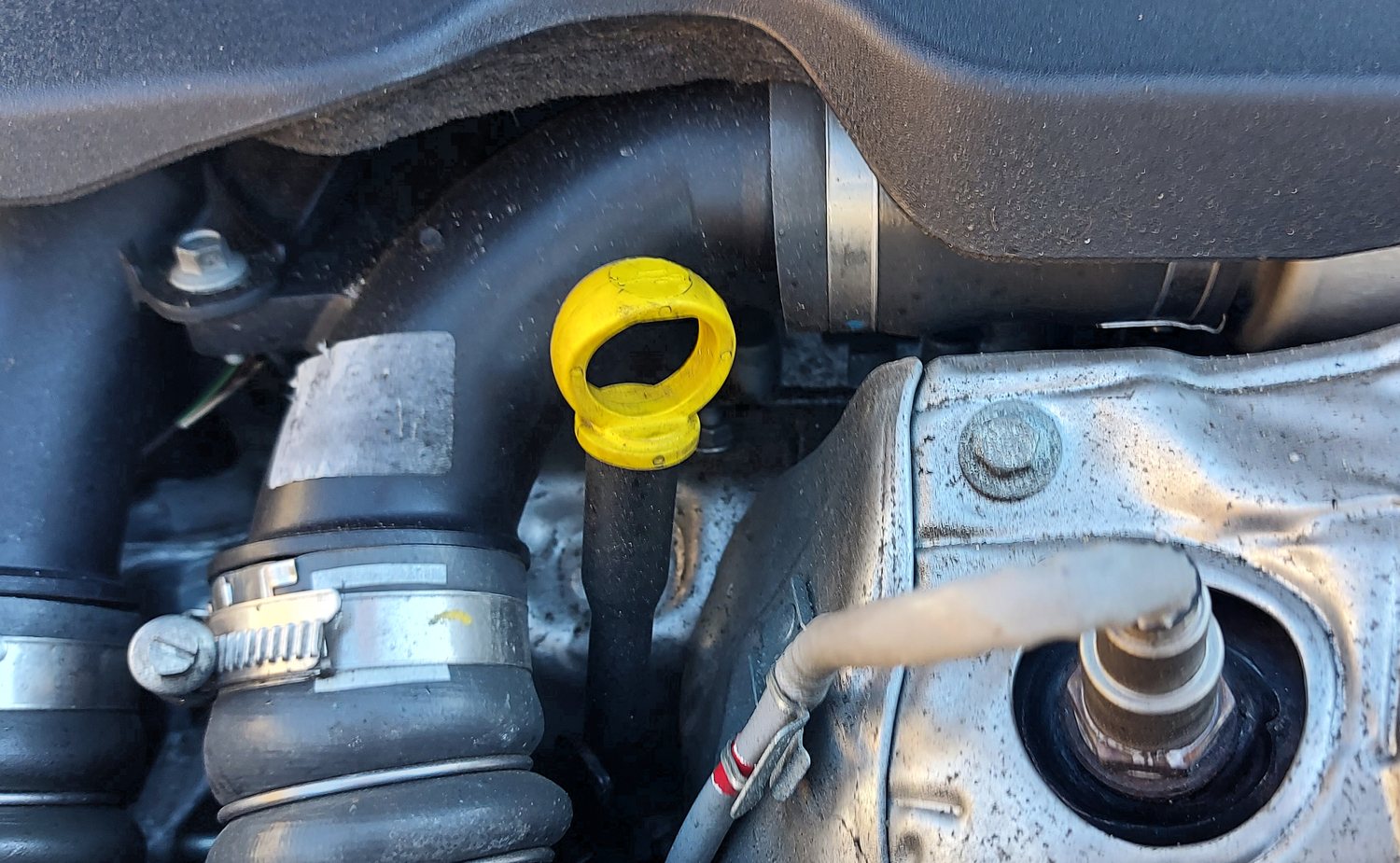
Identify the coolant expansion/header tank and explain that the level should be between the minimum and maximum markings. Check only when the engine is cool; never open a hot coolant cap.

Identify the brake-fluid reservoir and explain that the fluid should be between the minimum and maximum markings. If the level is low, seek advice rather than ignoring it.

Learn where each control is and what it does. On the test, demonstrate the action only when the examiner asks and it is safe to do so.

Use the rear-windscreen washer control on the right-hand steering-column stalk. On Joe’s teaching car, push the stalk away from you and hold briefly to apply washer fluid and operate the rear wiper. Keep your attention on the road and only do this when safe.
Use the front-windscreen washer control on the right-hand stalk. On Joe’s teaching car, pull the stalk towards you and hold briefly. The washer fluid and front wipers operate together.

Locate the exterior-lighting dial on the dashboard and select dipped headlights. Check the correct symbol/setting for the car you are using. On Joe’s teaching car, the dial is to the right of the steering wheel.

Use the rear-window demister button on the climate-control panel. Check the symbol showing a rectangular window with rising wavy lines. Press it to switch on; press again or allow it to switch off automatically, depending on the car.

Press the centre pad of the steering wheel. Only sound the horn when it is appropriate and safe to do so.
Use the climate controls to direct airflow towards the front windscreen. On Joe’s teaching car, the MAX demist setting can help clear the screen quickly. Adjust the fan and temperature as needed, and keep your attention on the road.

Use the electric window switch on the door panel: operate it in the appropriate direction to open or close the window. The layout can vary between cars.
Use this guide to revise, then ask Joe to test you on a few questions during your next lesson. The aim is to understand the answer and confidently locate the controls, not just memorise a script.
Contact JoeSafety note: never open a hot coolant reservoir or touch hot engine components. For checks that involve the engine bay, follow the vehicle handbook and practise with your instructor when conditions are safe.
Official source: DVSA — Car ‘Show Me, Tell Me’ vehicle safety questions ↗.